OPTICALITY: SEEING IN THE WAY OF THINGS (2026)
Introduction | About the Artists | How We Have Prepared |
liquid blackness in Conversation | Opticality: Seeing in the Way of Things Event (2026) | Opticality: Seeing in the Way of Things Portfolio
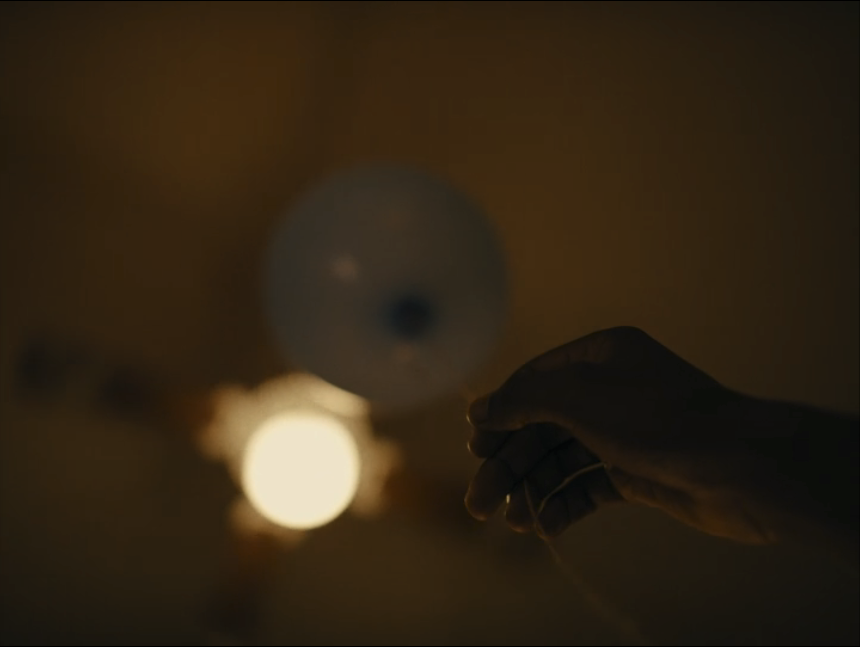
Still. Nickel Boys (2024) directed by RaMell Ross.
Introduction
Seeing in the Way of Things[1]
The seeds of this research project began with our 10th anniversary event, Music Video as Black Art: Claiming the B-Side (2023). In conversation with Kara Keeling, Stefano Harney poses the difficult and at times painful question of the separation from one’s community that results from “being sent.”[2] Often, one is sent as a child, when one’s family sends you into institutions of higher education in pursuit of the upward mobility they promise. This “being sent” is often an act of love and care, and sometimes a way to escape difficult conditions, but is also a being sent away—an act that will result in distancing, separation, a remove from the home but also from what the home holds, what it teaches, what it remembers.[3]
Harney reminds us that this is the place of the intellectual—like us—as well as the artist, and helps us to reflect on “the necessity of separation to the production of politics and art."[4] Borrowing from a poem by Amiri Baraka, Harney asks: “What does it mean to step away to see something in the way of things?”[5] He continues, “Once you step away, once you are sent, can you ever get back, back to what Clyde Woods called those blues universities where you learned everything? Or, can you bring the blues university to work with you? Can the blues university ever take you back?”[6]
Thus, we imagine that “seeing in the way of things” is also a way to practice a seemingly impossible return and therefore requires stepping to the side, to see otherwise, and following Fred Moten, eschewing a perspective altogether.[7] This “nonperspectival regard” sits in distinction to phenomenological occupation or object-oriented ownership, and instead calls for an emptying of the subject, an emptying of seeing through the self, not to fill another, but to be the hole, the gap, to be amidst. Or as Alessandra Raengo narrates it, a dispersal of individuation to be with the communal chatter of the ensemble—a deferral that places us with the practice, not the practitioner.[8] To return from being sent necessitates this different practice of seeing, seeing as gathering—not to see as a first, second, or third person (the I, the We, the Us, the You) but as a verb: a practice to be channeled rather than owned. We see “in the way of” as a process, a labor, a movement.
Continuities
For his 2017 installation, REkOGNIZE, Bradford Young turned to Pittsburgh’s Hill District, a site of The Great Migration, and the photography of Teenie Harris. Young says of the 3-screen installation, that he “use[d] [Harris’s] lens as a mapping of the ever changing social and physical landscape of the Hill District.”[9] In attempting to understand and therefore reproduce Harris’s photographs, Young found that his lacked the texture and quality of Harris’s. Despite retrieving some photograph’s metadata as a way to learn Harris’s handling of light and shadow and beyond the shifting landscape of the neighborhood because of time and social and cultural changes, Young saw that the air itself was different: the steel mills were dead, the source of so many middle-class jobs was gone, and the air was “cleaner.”
Young names Harris’s lens as the tool for mapping these textures of history, of exposing the metadata’s stories, and of tuning our senses towards the flows of community. In his attempt to arrive back, Young must see through the texture of the image, must dig into its metadata. To render out and render in the soul of a thing, place, and history requires seeing with the particulates in the air, the piling surface of the coat, rippling landscape of rooftops and treetops.
In Young’s going back to and rigorous study of Harris, we can find what Arthur Jafa, in conversation with production designer Akin McKenzie and cinematographer Shawn Peters, names as a practice of “continuity.” Not the blinkered linearity and progressive continuity of narrative cinema, but “social continuity, spiritual continuity, political continuity.”[10] This is a continuity of form—of tradition, songs, stories, dance, and memory. Continuity as a return—a going back to go elsewhere.
Opticality
What Young is after, what opticality attempts to narrate, are those knowledges and sensibilities that, Jafa says, are internalized and passed down, but also that which has been lost and taken, that which we seek to find once again.
Building on the forthcoming work of Alessandra Raengo, we see Young’s work on Harris as a labor of study—of preparing oneself to see through, to find, to learn, and orient with. Hence, more broadly, for us opticality narrates how artists excavate images, visions or memories that guide them when they sculpt their own. For Young, this is the lens, but we also want to know: what memories reshape and resculpt the colorist’s chromatic vision? What vibrational histories orient the production designer’s spatiality? Opticality is an engagement with our modes of seeing—what are the things that help us return, that allow us to open back up and empty out the things we learned and don’t serve us so that we can see anew.
Opticality, we propose, is just such an attempt. An aesthetic praxis that—in seeing in the way of things—begins to shrink that distance, attempts a return, seeks continuity but nevertheless holds how being sent can change us as evidence of what is, what has been, and what shall be. Opticality provokes us to ask how artists prepare, how they study, but also how they practice resisting this separation. Like the woodshedding jazz musician (a mode of practice we learn from cinematographer Chayse Irvin), how do artists work out their technique, find their foundation, and cultivate their phrasing so they can ultimately improvise with others?
[1] Part of the work of this introduction is to mark the many origin points that brought us to consider opticality, and to learn ways of studying it. While the writing you will see here and in the pages dedicated to this project and event expresses the collaborative and conversational work of the group, foundational not just to its language but to how it has been oriented and propelled is the profound work—previous and, most crucially, forthcoming—of Alessandra Raengo, liquid blackness’s founder and the mentor to each of us members. It is easy for her work to meld into the collective, and often that is the desire for all our contributions, for it is in our gathering that the work is possible. But we, her collaborators, want to name her more pointedly and lovingly here as an origin point alongside the many artists and thinkers that are narrated below.
[2] Stefano Harney, “Black Study as Aesthetic Practice,” liquid blackness, Vimeo, January 26, 2024. https://vimeo.com/906887773
[3] This conceptualization of “being sent” builds on the work of Guyanese feminist activist and writer Andaiye, who names it far more bluntly as “those we sacrifice into power” and Barbadian author George Lamming who writes of higher education that it is a “a complete wiping’ out” of memory, where the child is left with “only what they learn”—an emptying out of the self to enter “a derivative middle-class.” See Andaiye, “The Historic Centrality of Mr. Slime: George Lamming’s Pursuit of Class Betrayal in Novels and Speeches [2003],” The Point is to Change the World, ed. Alissa Trotz (Pluto Press, 2020).
[4] Stefano Harney, “Sent to See,” In Media Res (October 31, 2023). https://mediacommons.org/imr/content/sent-see
[5] Harney, “Sent to See.”
[6] Harney, “Sent to See.”
[7] Fred Moten, “Manic Depression: A Poetics of Hesitant Sociology,” Comparative Literature, University of Toronto, YouTube, April 7, 2017. https://www.youtube.com/watch?v=gQ2k0dsmIJE
[8] Alessandra Raengo, “Liquidities of the Black Arts,” book manuscript.
[9] Brentin Mock, “Bradford Young Trains His Lens on Pittsburgh’s Hill District,” Bloomberg, June 19, 2017. https://www.bloomberg.com/news/articles/2017-06-19/pittsburgh-s-hill-district-through-the-eyes-of-bradford-young.
[10] Film Roundtable, “Arthur Jafa and Akin McKenzie, moderated by Shawn Peters,” YouTube (July 28, 2023). https://www.youtube.com/watch?v=8tLU0ravGhs
About the Artists
For this event, we are excited to be joined once more by cinematographer Shawn Peters and colorist and director, Kya Lou.
In addition to these three artists, the understanding of “opticality” advanced by this research project builds on the work of cinematographers Jomo Fray, Autumn Durald Arkapaw, and Shabier Kirchner, and production designer Akin McKenzie.
We were drawn to the shared but divergent cinematography of the “dancehall/house party” of Steve McQueen’s Lover’s Rock (2020) and Ryan Coogler’s Sinners (2025). With Sinners, Autumn Durald Arkapaw rendered the vitalizing continuities of rhythm through a meticulous and yet fluid Steadicam shot that moves through the sonic, whereby the ecologies of the blues become a lens to feel out intimacies across time and cultures. Lovers Rock cinematographer Shabier Kirchner provokes a very different flow with a camera that leaves its distanced apprehending to become a sweating, grinding sonic body.[1] Kirchner pushed us to feel out the vibrational intimacies and radicalities of choosing to be with.
In this vein of “being with,” Jomo Fray tested the limits and ethics of that intimacy in his work on RaMell Ross’s Nickel Boys (2024), with what he termed “the sentient image.”[2] Pushing against the observing gaze of third-person perspective but also complicating the easy appropriation of the first-person perspective, Fray opens frameworks for seeing otherwise—to feel the life of things. So too does Akin McKenzie. In reflecting on his work, we were urged to reimagine our process and practice of study: how do we study that which is both filling the world—the production design—but is also meant to become background? His rigorous archival and communal research tasks us with seeing what he calls “the purpose” and “the patterns” of things, and how that aliveness can provide bridges connecting that which has been separated.[3]
[1] Henriques, Julian. Sonic Bodies: Reggae, Soundsystems, Performance Techniques, and Ways of Knowing. Bloomsbury Publishing, 2011.
[2] Joenique C. Rose, “Detail Oriented: ‘Nickel Boys’ DP Jomo Fray on Emotion Informing Images & His Time with Project Involve,” Film Independent, November 11, 2024. https://www.filmindependent.org/blog/detail-oriented-nickel-boys-dp-jomo-fray-on-emotion-informing-images-his-time-with-project-involve/
[3] Film Roundtable, “Arthur Jafa and Akin McKenzie, moderated by Shawn Peters,” YouTube (July 28, 2023). https://www.youtube.com/watch?v=8tLU0ravGhs
How We Prepared
In preparation for Opticality: Seeing in the Way of Things, liquid blackness organized a series of reading groups and screenings. These events were foundational in guiding us through a more expansive notion of opticality. Being in conversation with members of the liquid blackness academic and artistic community has proved vital in making this event and research project possible.
We have included here those screening series, reading groups, and “on deck” events (times of community gatherings to think together around specific themes and practices).
LENSES: THE PROBLEM OF GLASS READING AND SCREENING SERIES
SEPTEMBER 15-OCTOBER 6, 2025
September 15: To Tilt and Shift: John Akomfrah, Arthur Jafa, and the Problem of Glass
Screening:
Seven Songs for Malcom X (John Akomfrah, 1993)
Readings:
● Ba, Saer Maty, “Problematizing (black) documentary aesthetics: John Akomfrah's use of intertextuality in Seven Songs for Malcolm X (1993).” Studies in Documentary Film 1.3 (2007).
● Roberson, Mary-Russell, “Smooth as Glass,” Duke Science and Technology. https://dst.duke.edu/our-work/materials-science/smooth-as-glass/
● Van Genugten, Hilde, “The Glass Phase: A Physics Mystery,” Eindhoven University of Technology. https://www.tue.nl/en/news/features/the-glass-phase-a-physics-mystery
● Gutzow, Ivan S. “On the Etymology of the Word ‘Glass’ in European languages and some final remarks.” Glasses and the Glass Transition. Wiley Press, 2011.
September 22: Stretching Form, Part I: Malik Hassan Sayeed and the Abstraction of Light
Screening:
Clockers (Spike Lee, 1995)
Readings:
● Pizzello, Stephen. “Clockers: Between Rock and a Hard Place,” American Cinematographer, September, 1995. https://theasc.com/articles/clockers-lee-sayeed
● Greenberg, Clement. “Avant-Garde and Kitsch.” Art and Culture: Critical Essays. Boston: Beacon Press, 1961: 3-21.
● Greenberg, Clement. “Abstract, Representational, and so forth.” Art and Culture: Critical Essays. Boston: Beacon Press, 1961: 133-138.
● Heywood, Ian. “From Impressionism to Opticality: An Episode in Sensory History of Art.” Sensory Arts and Design, ed. Ian Heywood. Routledge, 2017: 225-238.
September 29: Stretching Form, Part II: Malik Hassan Sayeed and the Translucency of the Archive
Screening:
Belly (Hype Williams, 1998)
Readings:
● Thompson, Krista. “The Sound of Light: Reflections on Art History in the Visual Culture of Hip-Hop.” Shine: The Visual Economy of Light in African Diasporic Aesthetic Practice. Durham: Duke University Press, 2015: 215-270.
● Cramer, Lauren M. “Building the Black (Universal) Archive and the Architectures of Black Cinema.” Black Camera 8.1 (Fall 2016): 131-145.
● Tremblay, Jean-Thomas. “Breathing Against Nature.” Breathing Aesthetics. Duke University Press, 2022: 33-64.
October 6: Cinema as Weapon: The Opticality of Bradford Young and Chayse Irvin
Screenings:
When They See Us (Ava Duverney, 2019), “Part One”
Process (Kahlil Joseph, 2017)
Readings:
● Tobias, James. “The Music Film as Essay: Montage as Argument in Khalil Joseph’s Fly Paper and Process.” JCMS: Journal of Cinema and Media Studies 59.2 (Winter 2020): 157-162.
● Witt, Andrew (2020), “Roy DeCarava: Eyes to hear,” Philosophy of Photography, 11:1&2: 29-48.
● Ings, Richard. "‘And You Slip into the Breaks and Look Around’: Jazz and Everyday Life in the Photographs of Roy DeCarava." The Hearing Eye: Jazz & Blues Influences in African American Visual Art (2009): 303-331.
STILL SENT: FRED MOTEN AND LAURA HARRIS READING GROUP
SEPTEMBER 8-22, 2025
September 8: Andaiye and the Asset Class
Andaiye. The Point is to Change the World, ed. Alissa Trotz (Pluto Press, 2020).
● Forewords
● “The Historic Centrality of Mr. Slime: George Lamming’s Pursuit of Class Betrayal in Novels and Speeches [2003]”
● Gender, Race, and Class: A Perspective on the Contemporary Caribbean Struggle [2009]
● Walter Rodney’s Last Writing on and for the Guyanese Working People [2010]
Harney, Stefano, Zun Lee, and Fred Moten. “Black Shoals/Black-Scholes: On the Status of a New Asset Class.” In Seeing in the Dark, edited by Vera Mey, Philippe Pirotte, and Junyoung Hong. Busan Museum of Contemporary Art, 2024. Exhibition catalog.
Martin, Randy. "After economy? Social logics of the derivative." Social Text 31, no. 1 (2013): 83-106.
Moten, “On Criticism: Studying How We Are Together.” Portable Gray 7.2 (2024).
September 15: Experiments in Exile
Harris, Laura. Experiments in Exile: C. L. R. James, Hélio Oiticica and the Aesthetic Sociality of Blackness. Duke University Press, 2019.
Moten, Fred. Stolen Life. Duke University Press, 2018.
● “Knowledge of Freedom”
● “Gestural Critique of Judgement”
● “The Touring Machine (Flesh Thought Inside Out)”
September 22: Billie’s Bent Elbow
Okiji, Fumi. Billie’s Bent Elbow: Exorbitance, Intimacy, and a Nonsensuous Standard. Stanford University Press, 2025.
Moten, Fred. “Blue(s) as Cymbal: Beauford Delaney (Elvin Jones) James Baldwin.” Speculative Light: The Arts of Beauford Delaney and James Baldwin, ed. Amy J. Elias. Duke University Press, 2025.
Moten, Fred. Black and Blur. 2017.
● “Taste Dissonance Flavor Escape (Preface to a Solo by Miles Davis)”
● “Sonata. Quasi Una Fantasia”
● “The Phonographic mise-en-scène”
ON DECK: LENSES
OCTOBER 5, 2025
A gathering on the materiality and work of lenses with Georgia State University School of Film, Media & Theatre production faculty: Professor of Practice, Melba Williams; and Senior Lecturer, Robbie Land.
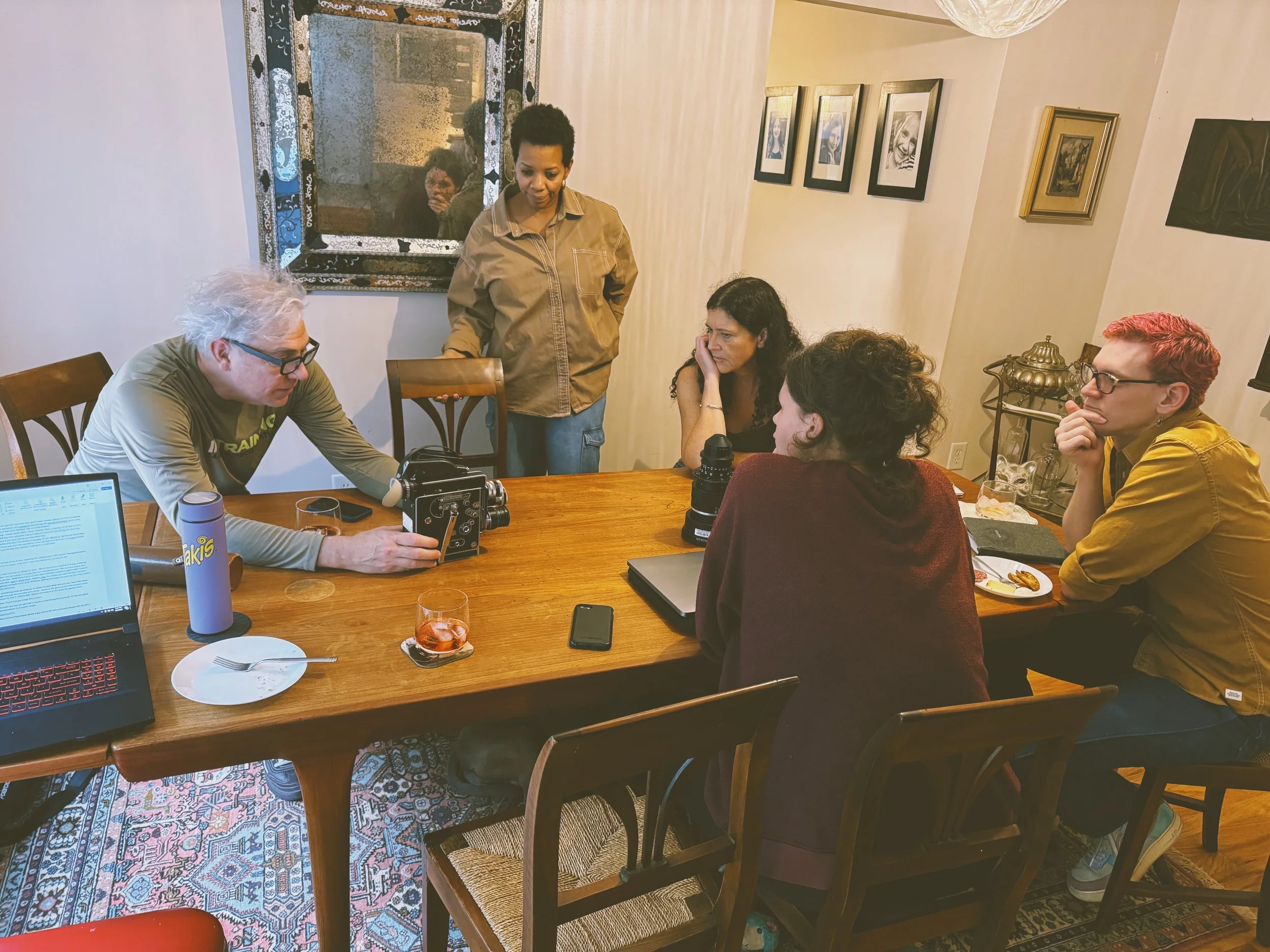
OPTICALITY: SEEING IN THE WAY OF THINGS READING GROUP
JANUARY 5-FEBURARY 1
January 5: The Sentient Image
Quashie, Kevin. Sovereignty of Quiet: Beyond Resistance in Black Culture. Rutgers University Press, 2012.
● “Quiet, Vulnerability, and Nationalism.”
Judy, R.A. Sentient Flesh: Thinking in Disorder, Poiesis in Black. Duke University Press, 2020.
● “Introduction: Body and Flesh”
● “Sentient Flesh”
Quashie, Kevin. Black Aliveness, or a Poetics of Being. Duke University Press, 2021.
● “Introduction: Aliveness”
● “Aliveness and Relation”
Jackson, James E. “The Touch of the ‘First’ Black Cinematographer in North American: James E. Hinton, Ganja & Hess, and the NEA Films at the Havard Film Archive.” Black Camera 10.1 (Fall 2018): 67-95.
January 12: Collecting | Preparing | Gathering
Wilkinson, Alissa. “Dahomey: A Daring Meditation of the Painful Legacy of Looted Artifacts.” New York Times, October 25, 2024.
Docalovich, Katrina. “Mati Diop in NYC.” Film Quarterly 78.3 (March 1, 2025): 85-89
Biah, Calixte and Bénédicite Savoy. “In Conversation: Museum Work and Experiences of Restitution.” Museum Worlds: Advances in Research 13 (2025): 145-153.
Cervenak, Sarah J. “Black Gathering: ‘The weight of being’ in Leonardo Drew’s Sculpture.” Women & Performance: a journal of feminist theory 26.1 (2016): 1-16.
Folland, Thomas. “Readymade Primitivism: Marcel Duchamp, Dada, and African Art.” Art History 43.4 (2020): 802-826.
Gorfinkel, Elena and John David Rhodes, The Prop. Fordham University Press, 2025.
● “Reading for the Prop”
● “Prop Value”
February 19: Blues Ecology: The Sounds and Politics of Place
Gilmore, Ruth Wilson. Abolition Geography: Essays Towards Liberation. Verso Books, 2023.
● “Abolition Geographer and the Problem of Innocence”
McKittrick, Kathrine and Clyde Woods, eds. Black Geographies and the Politics of Place. South End Press, 2007.
● McKittrick, Kathrine and Clyde Woods. “No One Knows the Mysteries at the Bottom of the Ocean.”
● Woods, Clyde. “‘Sittin’ on Top of the World’: The Challenges of Blues and Hip Hop Geography.”
Ivry, Henry. “How to Listen Otherwise: Black Sounds, Black Ecologies.” English Language Notes 62.1 (2024): 13-29
Tsing, Ann Lowenhaupt. The Mushroom at the End of the World: On the Possibility of Life in Capitalist Ruins. Princeton University Press, 2021.
● “Arts of Noticing”
● “Contamination as Collaboration”
February 1: The Dancehall: Sonic Flows, Vibrational Relations
Veal, Michael E. Dub: Soundscapes and Shattered Songs in Jamaican Reggae. Wesleyan University Press, 2007.
● “‘Every Spoil is a Style’: The Evolution of Dub Music in the 1970s”
Henriques, Julian. Sonic Bodies: Reggae, Soundsystems, Performance Techniques, and Ways of Knowing. Bloomsbury Publishing, 2011.
● “Introduction: Practising and Theorising Sounding.”
Semaj-Hall, Isis. “re-membering our Caribbean through a dub aesthetic.” Small Axe (February 2016). https://smallaxe.net/sxsalon/discussions/re-membering-our-caribbean-through-dub-aesthetic
Eisdsheim, Nina Sun. Sensing Sound: Singing and Listening as Vibrational Practice. Duke University Press, 2015.
● “Music as a Vibrational Practice: Singing and Listening as Everything and Nothing”
Boon, Marcus. The Politics of Vibration: Music as a Cosmopolitical Practice. Duke University Press, 2020.
● “Introduction: Music as a Cosmopolitical Practice”
ON DECK: OPTICALITY: SEEING IN THE WAY OF THINGS
JANUARY 23, 2026
A gathering to present the Opticality: Seeing in the Way of Things research project to the liquid blackness family of GSU, Emory, and Northwestern graduate students and faculty; liquid blackness alumni; and Atlanta-based artists.
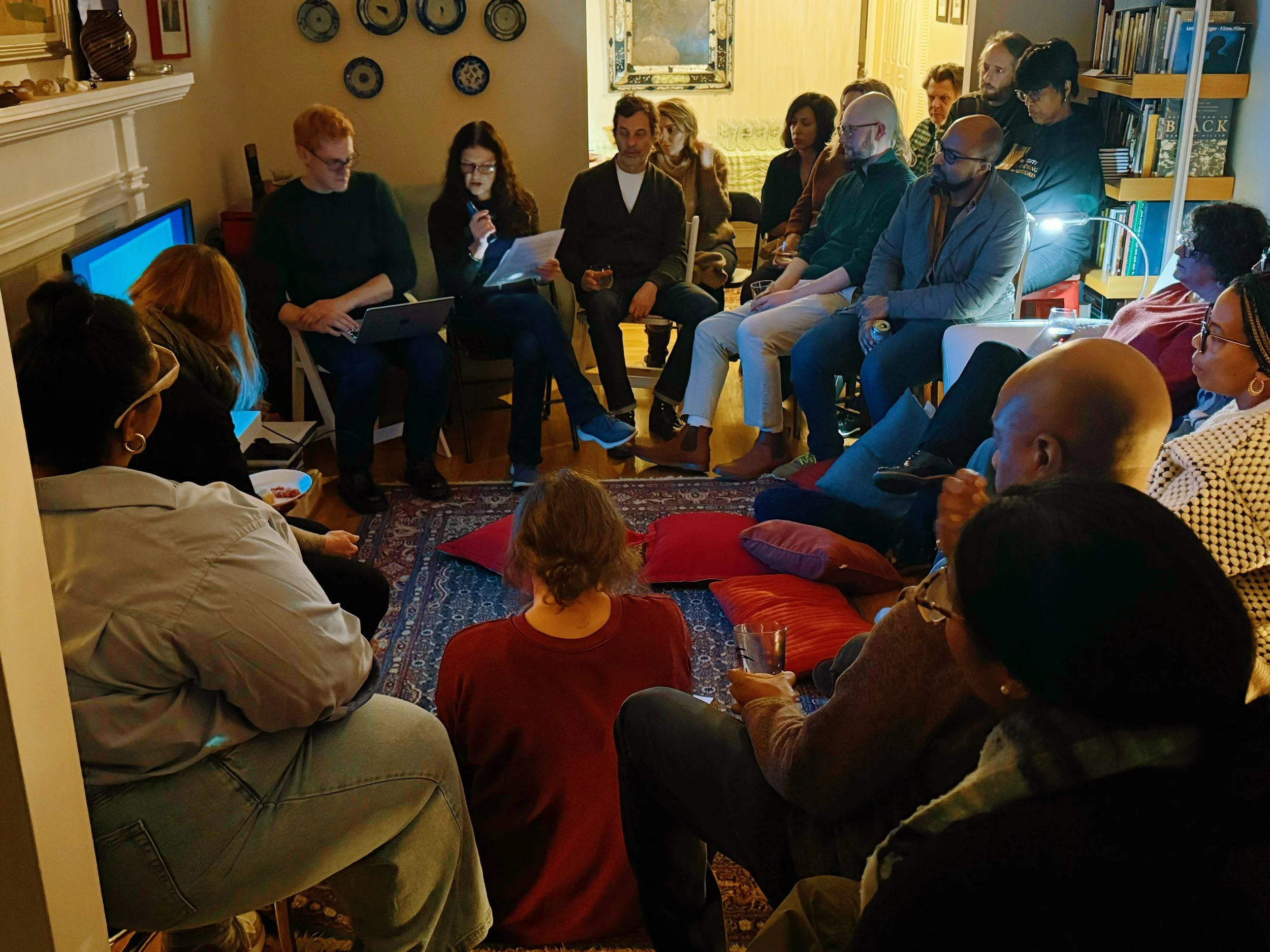
OPTICALITY: SEEING IN THE WAY OF THINGS SCREENING SERIES
JANUARY 21-FEBURARY 18
January 21: Jomo Fray and the Sentient Image
Screening:
● Nickel Boys (RaMell Ross, 2024)
Readings:
● Judy, R.A. “Introduction: Body and Flesh.” Sentient Flesh: Thinking in Disorder, Poiesis in Black. Duke University Press, 2020.
● Kevin Quashie. “Introduction: Aliveness.” Black Aliveness, or a Poetics of Being. Duke University Press, 2021.
January 28: The Buoyancy of Shabier Kirchner
Screenings:
● Lovers Rock (Steve McQueen, 2020)
● Dadli (Shabier Kirchner, 2018)
Readings:
● Julian Henriques. “Introduction: Practising and Theorising Sounding.” Sonic Bodies: Reggae, Soundsystems, Performance Techniques, and Ways of Knowing. Bloomsbury Publishing, 2011.
● Marcus Boon. “Introduction: Music as a Cosmopolitical Practice.” The Politics of Vibration: Music as a Cosmopolitical Practice. Duke University Press, 2020.
February 4: Shawn Peters: Baring the Face
Screenings:
● Something to Believe (dir. Terence Nance, 2010)
● Diasporadical Trilogia (dir. Blitz Bazawule, 2016)
● “Say Peace” (dir. A.G. Rojas and Darol Olu Kae, 2020)
● Univittelin (dir. Terence Nance, 2016)
● Burning Bridges (dir. Peters? 2016)
● Run this Town (dir. Kim Gherig and Tarjana Tokyo, 2023)
Readings:
● Richard J. Powell. “Introduction: Posing While Black.” Cutting a Figure: Fashioning Black Portraiture. University of Chicago Press, 2008.
February 18: Akin McKenzie: Patterns and Purpose
Screening:
● Native Son (Rashid Johnson, 2019)
Readings:
● Cervenak, Sarah J. “Black Gathering: ‘The weight of being’ in Leonardo Drew’s Sculpture.” Women & Performance: a journal of feminist theory 26.1 (2016): 1-16.
● Gorfinkel, Elena and John David Rhodes. “Reading of the Prop” and “Prop Value.” The Prop. Fordham University Press, 2025.
● Sexton, Jared. "All black everything." E-flux Journal 79 (2017): 1-12.
TEACH-IN: OPTICALITY: SEEING IN THE WAY OF THINGS
FEBRUARY 3, 2026
A presentation and conversation on the Opticality: Seeing in the Way of Things research project to Anjanette Lavert’s undergraduate documentary production class at Spelman University.
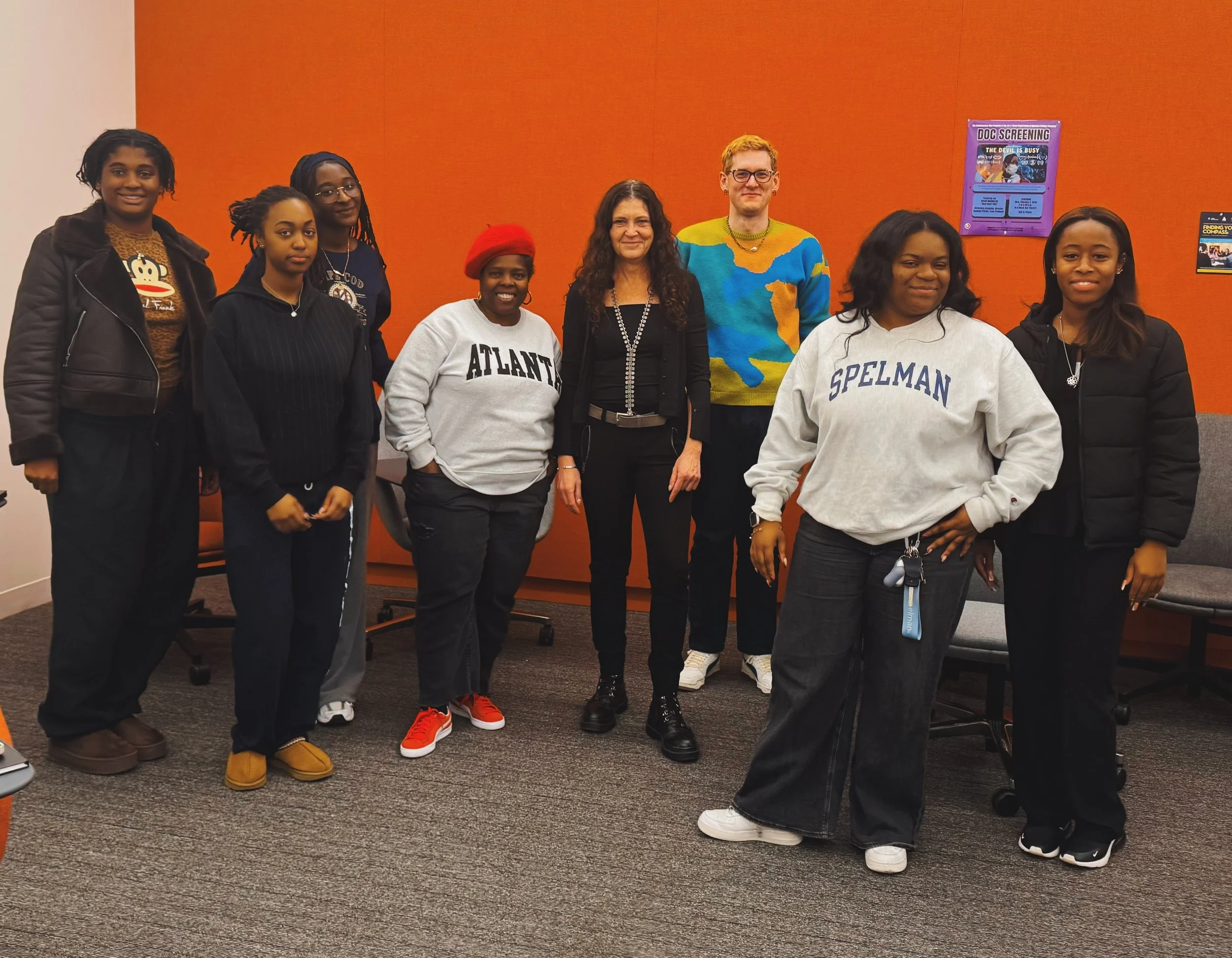
liquid blackness in Conversation with Kya Lou and Shawn Peters